Beijing Silk Street Market

Silk Street Market in Beijing Image Source: P1050094.JPG by jcortellLicense

This post started off a a Flickr Pick, but was promoted to the main area of the blog, as the Silk Street Market just proved to be too important.

The Silk Street Market is a landmark in modern Beijing and a popular shopping destination for tourists. It’s also called the Silk Market or Xiushuijie (in Chinese). Continue reading

Beijing Olympics – Fuwa Statues

gongfu_king posted a photo:

DSC_8637

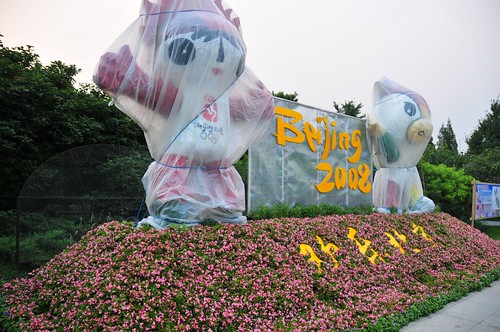
Giant Fuwa statues ready to celebrate the Beijing Olympics. They seem to be wrapped in plastic, so I guess they are brand new, ready for the celebrations.

The Fuwa are the official mascots of the Beijing Olympics. There are five of them and their names are Beibei, Jingjing, Huanhuan, Yingying and Nini. Drop the doubles and string them together and it makes Beijing huanying ni, which means welcome to Beijing (literally Beijing welcomes you).

Everyone in China seems to love them and their image is everywhere: on billboards, posters, school bags, keyrings, products, everywhere! You can’t escape them. It’s amazing the enthusiasm they inspire.

If you want more information on Fuwa, check out Wikipedia’s entry on them.

Pantao Chinese Flat Peach

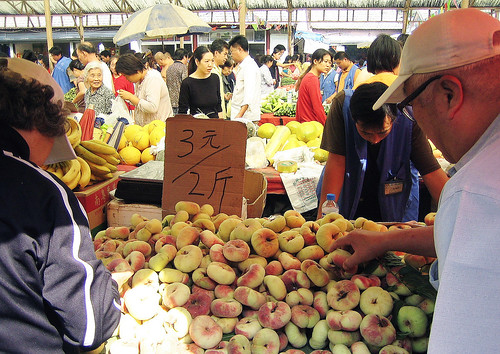
Here is a picture of some Chinese flat peaches, also called pantao, which are absolutely delicious. I’ve only ever seen them in China.

蟠桃 pántáo - 3元 / 2斤 photo by img_edv

They look like you took a normal peach and squashed the top and bottom points in to a third of the size of a normal peach, with the rest being pushed out to the sides. They taste like a normal peach, only a little sweeter.

I’ve found that fruit often tastes better in China. I think this is because a lot of the fruit is grown locally and is therefore fresher. Or maybe because the supermarkets care less about the fruit looking great than they do in the West and more about the taste.

After searching the Internet about this, I found a site with lots of information on the pantao. They agree with me that it’s delicious:

A peach that is juicy and sweet—many say the best tasting of all peaches—and creamy with a pit that does not cling wrapped in a nearly fuzzless skin: I want that peach!

They also point out that they are also known as the Donut peach. Whatever you call them, pantao are fantastic!

The price is worth noting: 3 yuan for 2 jin (1kg). That’s an amazing price.

China’s Dragon Boat Festival Holiday

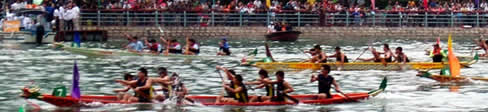
Dragon Boat Racing Image Source: Dragon Boat Racing by Mr WabuLicense

This is another post I wrote a little while ago and haven’t posted until now.

China’s Dragon Boat Festival (Duanwu) occurs on 5th May on the Lunar calendar. This equates to the following dates on the Western calendar:

  • 2012 date: 23 June
  • 2013 date: 12 June

As the name of the Festival indicates, it’s famous for Dragon Boat racing! People also eat zongzi (glutinous rice dumplings wrapped in bamboo leaves) and drink baijiu (Chinese wine) during this holiday. Continue reading

Dancing In Public

People dancing in public is some that happens a lot in China. People just gather together in a public square and dance. It must be a little more organised than that, because there is music playing over the load speakers, but it has a spontaneous feel to it and it’s a great way to pass a summer night.
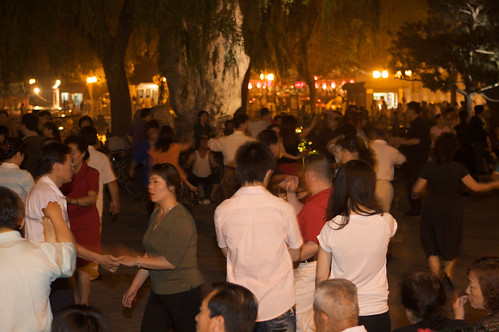
Dancing In A Public Square photo by LuxTonnerre

A nice photo of some people dancing in a public square.

I found an interesting story from the China Daily, called It’s time to bring out the dancing shoes. Here are a few quotes from the article:

It’s summer in China. And for millions of residents, that means it’s time to dance.

True, they come out of the woodwork at summer time. Here’s a little more detail:

Rather than frequenting private clubs or dance halls, many Chinese prefer to shake their groove thing outdoors, where the dancing is free. Many throw impromptu open-air dance parties that have the feel of an ice rink in reverse: The more advanced take to the outside while the beginners wobble about in the middle.

But even though it’s common, it’s still not seen as acceptable by everyone:

Still, many Chinese men consider ballroom dancing too feminine. “So we have many all-female pairs,” said Yin Guochen, general secretary of the Chinese DanceSport Federation. “People are traditional. Many think that having an unmarried man and women as dance partners might cause problems, like an affair.”

Very traditional thinking that. I’ve seen quite a few dances in public and there are always men there – although I have seen men dancing with men and women dancing with women.

It’s not always ballroom or traditional Chinese dancing. Sometimes it’s modern dancing too. Well sort of modern. One memory has stuck with me from 2002, when after watching a fountain (that’s another story), the following words rang out across the square:

Boom Boom Boom,
Lets go back to my room,
So we can do it all night,
And I can make you feel right.

That song is from the mid 1980s… I’m not sure if anyone understood the lyrics! I’ll assume not. Regardless, they all had a great time dancing.
Hua Shan (Mount Hua)

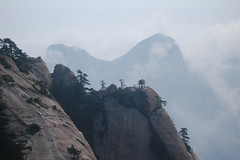
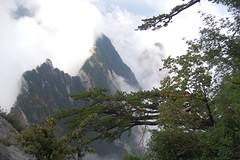
Hua Shan, or Mount Hua as it is known in English, is absolutely breathtaking. That’s a phrase that is often overused, but there is no doubt that it applies to Hua Shan.

DSC_5038  DSC_4995

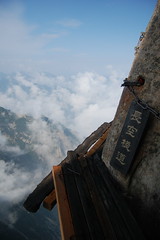
DSC_5012  DSC_5005
photos by Darren On The Road

I’ve always been a sucker for mountains in the mist. Wait a minute, that’s cloud, not mist! Hua Shan is really high up – 2160 metres (which is 7087 feet).

Here is a quick quote from Wikipedia’s entry on Hua Shan:

Mount Hua is located in the Shaanxi Province, about 100 kilometres east of the city of Xi’an, near the city Huayin. Hua was historically the location of several influential Taoist temples, and was known as a centre for the practice of traditional Chinese martial arts.

I love the pagoda on the edge of the mountain. That’s very Chinese. They’ll build pagodas and temples anywhere, no matter how difficult it must be to build it. The bottom left photo shows ribbons which have been tied onto the trees, presumably by climbing out on the branches, with nothing below them.

However, the most amazing photo is the last one: A photo of the path with nothing underneath it. Seems that’s for walking on! Amazing.

Xian Terracotta Warriors

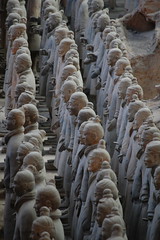
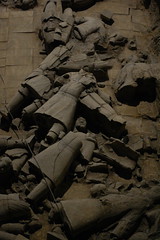
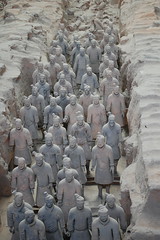
I’ve never been to Xian or seen the Terracotta Warriors, although I plan to one day. I’ve seen some great photos of the Terracotta Warriors and they’d have to be one of the most photographed things in China.

DSC_4906  DSC_4896

DSC_4881  DSC_4897
photos by Darren On The Road

These photos go really well together – it’s just a pity that one’s the wrong shape to fit with the rest, otherwise this set would be close to perfect. The different colours and tones really complement each other and are very effective.

I particularly like the photo of the smashed up warriors. That’s not the standard photo that you see of the Terracotta Warriors.

I’m really getting to like Darren On The Road‘s photos – he sure knows how to take a good shot. Get over to his Flickr page and check his photos out.

Beijing Street Scene

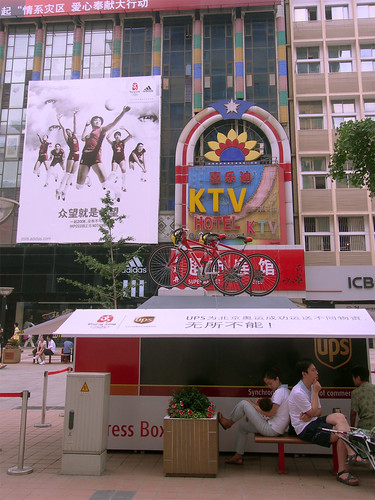
This photo of a Beijing street scene has a lot in it:

box
photo by myuibe

  • The volleyball advertisment: I’ve always thought that this advertisement is cool. Looks great.
  • The KTV Hotel: which you can find throughout in China – although I’m not into Karaoke myself, KTV is an important part of everyday life in China.
  • Bicycles on top of a hut: which seems to be UPS hut, providing bicycle couriers I guess. Modern China.

But the real value in this photo comes from the couple sitting on the bench. Their positioning is great: leaning against each other, while the mother nurses the baby, her leg up against the plant holder. Its a classic!

The other stuff in the photo is interesting, but without the couple, it would not add up to a photo I’d pick to highlight on JobsInChina. In fact, the photo would probably benefit from cropping the rest out and making the couple the focus of the photo.

Click on the photo to see the bigger image at the Flickr site. You’ll be able to see the details much more clearly.

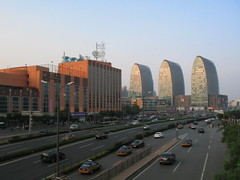
Xizhimen District In Beijing

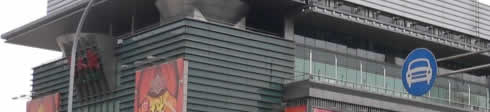
The office buildings in the Xizhimen area of Beijing are a fairly notable landmark.

Xizhimen
photo by denn

Accordint to Wikipedia’s Xizhimen entry:

formerly a gate in the Beijing city wall and is now the name of a transportation node in Beijing. The gate formerly was the entrance of drinking water for the Emperor, coming from the Jade Spring Hills to the west of Beijing. The gate itself was demolished in 1969.

The 2nd Ring Road currently links with Xizhimen Outer Street, which has recently been transformed into a city express road, linking the western 2nd Ring Road via Beijing Zoo to the 3rd Ring Road. A triple-arched highrise building is a noticeable landmark at the intersection.

It’s also has two underground stations (one for line2 and one for line 13) that are close together, but not actually connected.

Also of note in the photo are the ubiquitous Beijing taxis, which every visitor to Beijing is probably familiar with.

Birds Nest Olympic Stadium

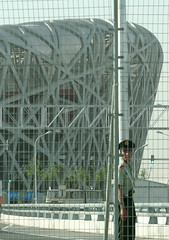
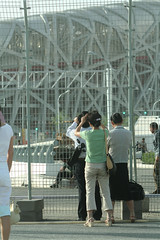
The Bird’s Nest Olympic Stadium in Beijing is one of the most photographed structures in the world. I’m sure I’ll come across many more photos of the stadium in the coming months, leading up to the 2008 Beijing Olympics.

IMG_5883  IMG_5879

Birds Nest  IMG_5881
photos by céd

In terms of capturing the stadium itself, these photos aren’t that great, especially when compared to many others that I’ve seen. You can’t see the whole stadium. The fence is in the way. You can’t see much of the sky, but it seems to be smoggy.

But despite that, these photos really work.

I really like the way that céd has captured people and vehicles in the foreground. That adds a lot of interest to the picture. I especially like the photo with the soldier and the one with the bulldozer.

These photos definitely work well as a set. Each picture works well by itself, but together, they add something to the whole.